What Is an All-on-4 Implant?
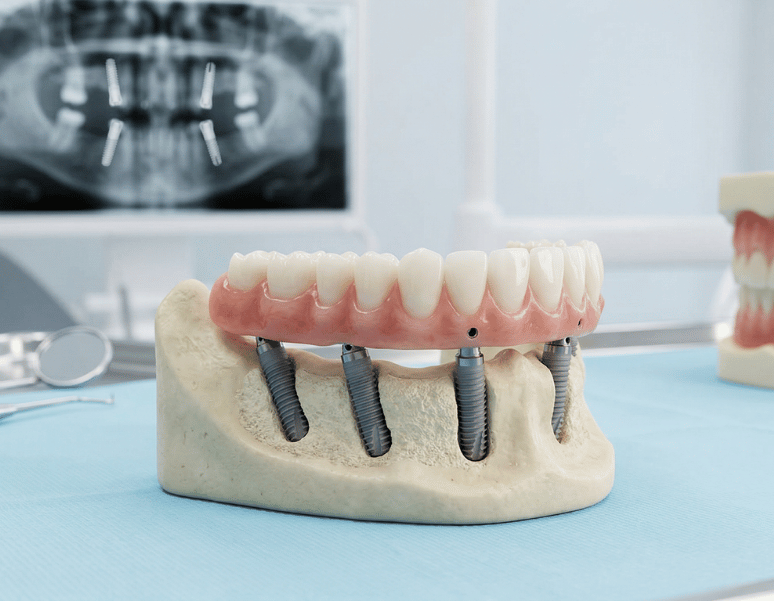
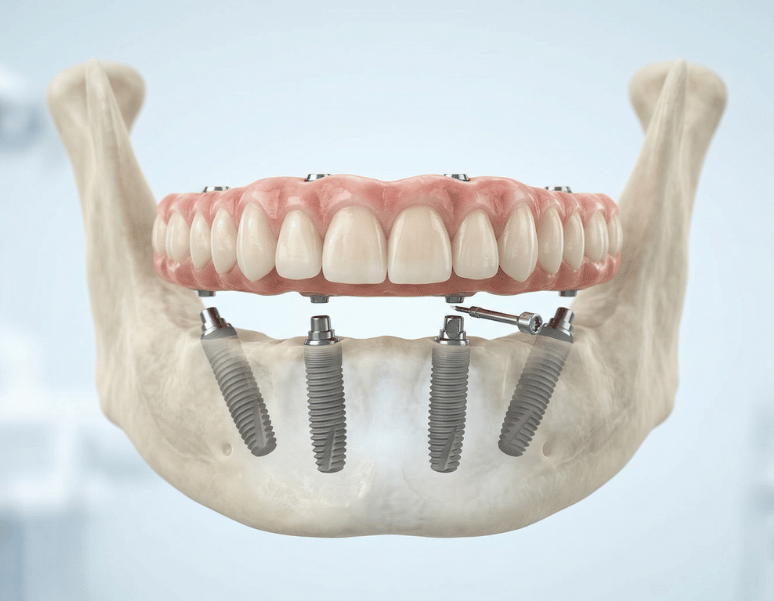
• Explain that All-on-4 Implant is a full-arch restoration method where a fixed prosthesis is supported by four dental implants.
• Mention that implants are placed at strategic angles to maximize support, especially in patients with limited bone in certain areas.
• Clarify that it is commonly used for patients who have lost all or most teeth in the upper jaw, lower jaw, or both.
• Emphasize that treatment planning requires clinical examination and radiological imaging.

How Does the All-on-4 Implant Technique Work?
• Describe the basic concept of placing two implants in the front region and two implants in the back region at an angle.
• Explain that this positioning may reduce the need for additional procedures such as sinus lifting or bone grafting in selected cases.
• Mention that a temporary fixed prosthesis can often be attached after implant placement, depending on the patient’s condition.
• State that a permanent prosthesis is usually prepared after the healing and osseointegration period.
Who Is a Suitable Candidate for All-on-4 Implant?
• Explain that candidates may include patients with complete tooth loss, severely damaged teeth, or difficulty using removable dentures.
• Mention the need for sufficient bone quality and quantity, healthy gums, and general health suitable for implant surgery.
• Include that systemic diseases, smoking, uncontrolled diabetes, or certain medications may affect suitability and healing.
• Emphasize that the final decision must be made after detailed dental and medical evaluation.
Patients With Complete Tooth Loss
• Explain how All-on-4 Implant can provide fixed teeth for patients who are fully edentulous.
• Mention improved chewing, speech, comfort, and confidence compared with removable dentures.
Patients Who Struggle With Removable Dentures
• Cover common issues such as movement, discomfort, gag reflex, difficulty eating, and reduced confidence.
• Explain that fixed implant-supported prostheses may offer a more stable alternative.
Advantages of All-on-4 Implant Treatment
• Explain the possibility of fixed full-arch teeth with fewer implants compared with traditional full-mouth implant approaches.
• Mention shorter surgical time and fewer treatment sessions in suitable patients.
• Cover aesthetic smile design, improved chewing function, and easier adaptation because the prosthesis does not fully cover the palate like traditional dentures.
• Add that it can be a practical option for international patients because the treatment plan can often be structured around travel schedules.
Initial Examination and Digital Planning
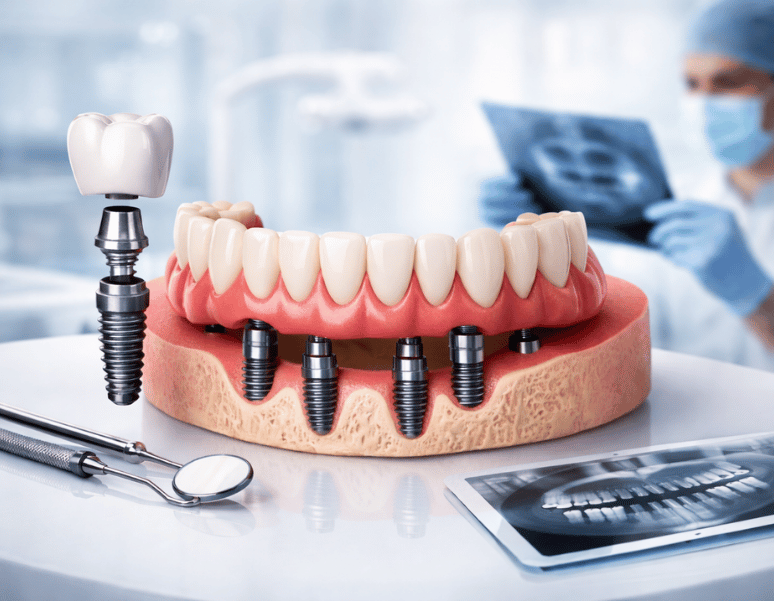
• Include consultation, medical history, intraoral examination, panoramic X-ray, and 3D tomography when needed.
• Explain that measurements help determine implant position, prosthesis design, and treatment suitability.
Implant Placement Surgery
• Explain that four implants are placed in the jaw according to the treatment plan.
• Mention that the procedure is usually performed under local anesthesia, with sedation options for anxious patients when appropriate.
All-on-4 Implant Treatment Stages
• Present the process step by step without making unrealistic same-day guarantees.
• Explain that the timeline may vary depending on oral health, bone structure, healing capacity, and whether extractions or additional procedures are needed.
• Mention that digital imaging and clinical planning are important for safe and predictable treatment.
• Include both surgical and prosthetic phases.
Healing and Osseointegration
• Explain that implants need time to integrate with the jawbone.
• Mention that this period is commonly around a few months, but timing may vary from patient to patient.
Temporary Fixed Prosthesis
• Explain that a temporary prosthesis may be placed after surgery if primary implant stability is sufficient.
• Mention that this temporary prosthesis supports appearance and basic function during healing but requires dietary care.
Is All-on-4 Implant Painful?
• Explain that the surgery is performed under anesthesia, so patients should not feel pain during the procedure.
• Mention that mild to moderate swelling, tenderness, or discomfort may occur after surgery.
• State that postoperative symptoms can usually be managed with prescribed medication and dentist instructions.
• Reassure anxious patients while still keeping the medical tone realistic.
Permanent Prosthesis Placement
• Explain that the final prosthesis is prepared after healing is complete.
• Mention that the permanent prosthesis is designed for long-term function, comfort, aesthetics, and easier maintenance.
Anesthesia and Sedation Options for Anxious Patients
• Explain that local anesthesia is commonly used for All-on-4 Implant surgery.
• Mention that sedation or general anesthesia may be considered for patients with high dental anxiety, strong gag reflex, or complex cases.
• Clarify that anesthesia choice depends on medical history, procedure complexity, and dentist or anesthesiology evaluation.
• Emphasize patient safety and preoperative assessment.
Recovery and Aftercare After All-on-4 Implant Surgery
• Cover swelling, oral hygiene, medication use, smoking avoidance, and follow-up appointments.
• Explain the importance of cleaning around the prosthesis and implants to prevent inflammation and implant complications.
• Mention that patients should follow their dentist’s instructions carefully during the healing period.
• Add that long-term success depends on both professional maintenance and daily home care.
Eating and Nutrition After All-on-4 Implant Treatment
• Explain that patients should follow a soft-food diet during the healing phase to protect the implants.
• Mention that hard, sticky, or crunchy foods should be avoided until the dentist confirms that healing is complete.
• Include practical examples such as soups, yogurt, mashed vegetables, eggs, soft pasta, and smoothies.
• Explain that normal chewing may gradually improve after the permanent prosthesis is placed and the dentist gives approval.
Follow-Up Appointments
• Explain that follow-up visits allow the dentist to assess healing and make prosthetic adjustments if needed.
• Mention that international patients should plan their travel schedule according to the recommended control appointments.
Oral Hygiene With All-on-4 Implant Prosthesis
• Explain the need for brushing, interdental cleaning tools, water flossers, or special brushes recommended by the dentist.
• Mention that regular check-ups help monitor gum health, prosthesis fit, and implant stability.
All-on-4 Implant vs Traditional Dentures
• Compare fixed implant-supported prostheses with removable full dentures in terms of stability, comfort, chewing, speech, and confidence.
• Explain that All-on-4 Implant does not rely only on gum support like traditional dentures.
• Mention that removable dentures may move or cause discomfort, while implant-supported prostheses provide improved stability.
• Clarify that the best option depends on oral health, expectations, budget, and clinical findings.
Success Rate and Longevity of All-on-4 Implant Treatment
• State that clinical studies report high long-term success rates for All-on-4 Implant treatment in suitable patients.
• Emphasize that outcomes vary depending on bone quality, systemic health, oral hygiene, smoking, treatment planning, and follow-up care.
• Avoid guaranteeing lifetime results; explain that prosthetic components may require maintenance or replacement over time.
• Mention that regular dental visits are important for long-term success.
Planning All-on-4 Implant Treatment for International Patients
• Explain that international patients should share dental X-rays, medical history, and expectations before travel when possible.
• Mention that treatment planning may include consultation, imaging, surgery, temporary prosthesis, healing period, and final prosthesis visit.
• Cover the importance of clear communication about travel dates, recovery time, and follow-up needs.
• Emphasize that patients should not choose treatment only based on speed; safety and suitability must come first.
All-on-4 Implant vs Traditional Dental Implants
• Explain that traditional full-arch implant treatment may require more implants and additional surgical steps in some cases.
• Mention that All-on-4 Implant may reduce treatment time and the need for bone grafting in selected patients.
• Clarify that traditional implants may still be more appropriate for certain cases.
• Encourage balanced comparison based on individual anatomy and treatment goals.
Possible Risks and Considerations
• Mention that, like any surgical treatment, All-on-4 Implant may involve risks such as swelling, infection, implant failure, prosthesis adjustment needs, or delayed healing.
• Explain that careful diagnosis, sterile surgical conditions, correct implant positioning, and aftercare reduce risks.
• Mention that uncontrolled systemic conditions and smoking may increase complication risk.
• Keep the tone informative and balanced, not alarming.
Plan your smile with free consultation. Book your online appointment in 30 minutes.

Frequently Asked Questions About All-on-4 Implant
All-on-4 Implant Prices in Turkey (2026)
All-on-4 implant prices vary depending on the implant brand used, the type of prosthesis to be applied, and the patient’s jawbone structure. Treatments offered in Turkey are performed at much more affordable prices with the same quality standards compared to Europe.
✅ Free preliminary consultation
✅ Transparent pricing
✅ Personalized treatment planning
Why Should You Choose Turkey for All-on-4 Implant?
- Cost advantage of up to 60-70% compared to Europe
- Experienced and expert implant dentists
- Clinics equipped with state-of-the-art technology
- Opportunity to combine treatment with a holiday
- Fast treatment process and quick results
Why Should You Choose Dentasay?
Dentasay Oral and Dental Health Clinic offers a high success rate with modern techniques and digital planning in All-on-4 implant treatment. Thanks to our patient-focused approach, we ensure you achieve the best results both aesthetically and functionally.
- Service tailored to international patients
- Same-day teeth (immediate loading) options
- High sterilization standards
- Affordable price, high quality balance
Who can get All-on-4 implants?
All-on-4 implant treatment can be applied to patients who are completely edentulous or about to lose all their teeth. It is also a suitable solution for many patients with limited bone volume. It is ideal for those who want fixed teeth and do not want to use removable dentures.
How is the All-on-4 procedure performed?
The treatment is performed by placing 4 implants into the jawbone at special angles. The procedure is usually done under local anesthesia. Temporary fixed teeth are placed on the same day so the patient is not left toothless. After healing, permanent prostheses are applied.
What are the preparation stages before treatment?
Before treatment, a detailed examination, panoramic X-ray, and 3D tomography are performed. This allows analysis of the bone structure and planning the most accurate positioning of the implants. Additional procedures are determined in advance if necessary.
What is the healing process like?
Mild pain and swelling may occur after the procedure, but it usually subsides within a few days. The process of implants fusing with the bone (osseointegration) takes an average of 3-6 months. Temporary teeth continue to be used during this period.
What are the advantages of All-on-4 implants?
- Opportunity to have fixed teeth in a short time
- Full mouth restoration with fewer implants
- Often eliminates the need for bone grafting
- Provides aesthetic and natural appearance
- Restores chewing and speaking functions
- Much more comfortable than removable dentures
How to care for All-on-4 implants?
Implants should be brushed regularly like natural teeth, and oral hygiene should be maintained. Use of dental floss and oral irrigator is recommended. Regular dental check-ups are very important for the longevity of the implants.
How long does All-on-4 treatment take?
Implant placement is usually completed in a single session, and temporary teeth are placed on the same day. Permanent prostheses are typically applied after 3-6 months. The total treatment duration may vary depending on the patient’s condition.